Showing posts with label pharmaceutical drugs. Show all posts

Sunday, November 13, 2011

the 2011 NADA conference

So, the 3rd weekend of May I attended the 22nd Annual NADA (National Acupuncture Detoxification Association) conference in Kansas City, MO. This year's conference theme was "NADA Communities of Recovery & Psychological First Aid" which theme its panels and other sessions explored over 2 days.


NADA is a non-profit organization which promotes training and advocacy for the 5-needle auricular acupuncture protocol and its uses. Originally developed for and seen in the field of substance abuse treatment, the NADA protocol has been widely used in treatment facilities all across the U.S., as well as internationally. Recently, the benefits of this deeply calming natured protocol have been recognized and used in other settings including mental health treatment sites and in disaster response (for example by Acupuncturists without Borders in New Orleans, Haiti and elsewhere) to forestall PTSD. Only
about 40% of the membership are acupuncture professionals, with the rest of the membership being psychiatrists, nurses, chemical dependency counselors, social workers, etc. Although it the NADA protocol is an acupuncture technique, employing acupuncture needles, it is also performed (actually largely performed in public-health settings) by non-acupuncture professionals, and most particularly by NADA-certified trainees. About 21 states permit these trainees to perform NADA (usually under supervision of licensed acupuncturists).

The conference keynote speaker was Robert Whitaker, investigative journalist and author of several books. He wrote Anatomy of An Epidemic about the history of mental illness in the "age pf psychopharmacology". I am currently reading this book, and plan to write up a book review later when I've finished (yes, I am just that geeky!). Some small tidbits from his talks:
* the "anti" (e.g. "antibiotic") disease model of mental illness began in 1955 with the introduction of Thorazine; from that point we have had a "profound leap forward" to psycharmaceutical drug spending of 40 billion dollars a year. (The mind more than boggles at such a figure -- it leaps free from its moorings & does a series of manic pirouettes!)
* Whitaker's central, simple query is: if these medications are so effective, shouldn't the mental illness disability rate drop? Or at least stabilize? One would think so, yes? Instead, the numbers indicate an ever-increasing rise in both mental illness diagnoses and the numbers of people who are determined to be so disabled by their diagnoses that they are classified as unable to be productive members of society. Surprisingly our disability rates are being swelled not by psychotic diagnoses, but by the "less severe", more transient affective disorders. Bipolar disease -- once a rare occurrence in the not-so-distant past -- is now appearing in society at the rate of 1 of every 50 adults.
* Although the biological basis for mental illness istill not definitively known (even the beloved serotonin "deficiency" theory doesn't hold water), it is still being "treated."

 
Other presentations at the conference included the use of a modified NADA protocol in a pilot program at Walter Reed military Hospital in Bethseda, which was targeted towards medical caretaker personnel; a rough draft of a documentary film by Brian Lindstrom which explored the implementation of the NADA protocol in psychiatric treatment centers in Eruope, and a report from “Acupuncturists Without Borders” Haiti Operations Manager, Julia Ranieri, about AWB operations in Haiti since the 2010 earthquake.

(Just after the conference ended, a deadly tornado hit Joplin in southern Missouri, and volunteer practitioners from both NADA and AWB mobilized to offer affected populations auricular acupuncture treatments.)
My personal relationship with NADA started as a student with my NADA training in 2000, which was a required part of my AOM education, and continued with my professional experience in a substance abuse treatment center. In my opinion, the existence of NADA & ADS'es benefit acupuncture physicians & our profession, both directly & indirectly. Directly with job creation (when professional acupuncturists supervise ADS'es) and as a source of referrals to “real” acupuncture for clients who have been introduced to the NADA treatments; and indirectly because the bulk of acupuncture treatments in the public health forum is occurring in NADA-centered clinics, and their existence helps to influence & expand the general public's view of the usefulness of our medicine. Additionally, the NADA organization has been compiling & organizing a treasure trove of outcomes-based research on acupuncture care for decades.
For more information on NADA, including specific details on upcoming trainings, I urge you to please contact NADA, via their website: www.acudetox.com.

Sunday, September 5, 2010

Eye of Newt & Toe of Frog ...

Fillet of a fenny snake,
In the cauldron boil and bake;
Eye of newt, and toe of frog,
Wool of bat, and tongue of dog,
Adder’s fork, and blind-worm’s sting,
Lizard’s leg, and howlet’s wing,
For a charm of powerful trouble,
Like a hell-broth boil and bubble.


Double, double toil and trouble;
Fire burn and cauldron bubble.
(Macbeth by W. Shakespeare; Act IV, Scene 1)

I think that there is a general impression that Chinese herbal medicines (CHM) are made from all sorts of super-icky things (and there's no dispute on the errors of overuse of tiger bones and rhino horns!) Actually, about 85-90% of the most commonly used herbs in the Chinese materia medica (which is roughly counted as 1500 items) are plant-based. We have roots, twigs, leaves, flowers. I often like to joke when dispensing bags of raw herbs that they are "lawn sweepings" -- but good for you!

Because it is a traditional cultural use medicine, some of the theories that CHM is organized around include the "signature effect" (not unique to the Asian materia medica), the thinking that an herb source's form will indicate its use. Some reflections of this are theory are:
  • flowers & plants that succesfully struggle to grow high on mountains are more "yang" & can tonify such a deficiency
  • aerial plant parts, or branches are used to treat a patient's limbs
  • "bleeding flees from black" (charred herbs are styptic)
  • dense and juicy tubers or fruits can nourish "yin"
  • small, wriggly bugs (yes, bugs) can seek out blood stagnation in the tiny channel collaterals.
These types of theories partially inform the theory of the herbal medicine that we practice (other theories and classifications of herbal substances are more based on empirical observation of their uses). Interestingly, a lot of the modern pharmacological research being conducted in Asia is meant to "prove" in biochemical terms the veracity of these old theories (and seems to frequently do so).

Chinese herbs don't hold the franchise on the"ick" factor -- some modern pharmaceuticals have gross origins too! Some of these include fish semen (used to treat heparin overdoses), rat poison (Coumadin), pregnant mares' urine (Premarin).

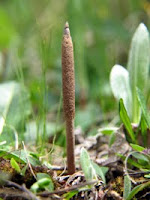
bulbous buttercup
Note: Please, those of you who are taking Coumadin, please do become familiar with its side effects, as this drug can have very serious risks (gangrene or death).

p.s. It is actually thought that some, or most of the ingredients in the witches' brew listed above were actually names of plants. "Eye of newt" may have been mustard seeds; "toe of frog" a reference to bulbous buttercup; "tongue of dog" a plant in the borage family, and so forth!

Tuesday, July 27, 2010

A Chinese Herb & M.S.

The Wall Street Journal recently ran an interesting story, entitled "MS Drug's Epic Journey from Folklore to Lab" -- the subject being an herb from the traditional materia medica of Chinese medicine, called dong chong xia cao (winter bug summer herb). This "herb" itself is an interesting amalgamation -- it is actually a fungus that grows upon a worm and eventually takes over its carcass as a home. This type of growth is called an endoparasitoid -- not very appealing to the ethical vegetarian!

Dong Chong Xia Cao has a relatively recent history in Chinese herbal medicine: only some 300 years of documented use. It is classified as a Kidney yang tonic, which generally means a warming tonic but this herb doesn't damage yin in the process, so it's not too drying. It is especially known for its use in treating respiratory diseases as it settles coughs & wheezing. In recent decades. it's gained some notoriety for its use in improving Chinese athletes' performance. It is mostly harvested from the provinces of Tibet, Sichuan, & Qinghai, -- where its value has recently increased, even causing little frontier wars over collection rights. Despite its rather "icky" provenance, dong chong xia cao is considered a gentle tonic with very little toxicity.

Multiple sclerosis (usually just known as "M.S.") is a neurological disease of unknown etiology. It was recognized as a disease-syndrome in the 1868, by a famous neurological physician, Jean-Martin Charcot (this doctor conducted wide-ranging clinical work & research in neurological disorders, hysteria and hypnosis). For an unknown reason, the body itself apparently attacks the myelin sheath of the central nervous system, giving rise to a variety of neurological symptoms (changes in sensation, muscle weakness, fatigue & others).

Most modern pharmaceutical drugs are derived from herbs -- often from research that looks at herbs with specific medicinal functions. The working theory is that by extracting what is presumed to be the most "important" element of the herb, and then concentrating, or standardizing it, the resultant product will have an amplified ability to do whatever the source herb does. It's an interesting approach, this idea of isolating the single curative element from a raw material. But what if it's wrong? What if removing one element from an herb -- or one herb from a formula -- reduces its efficacy, or increases its toxicity, or unleashes heretofore unseen side effects? (Note that in this article, the isolated element of dong chong xia cao was too toxic for human use -- despite the herb's actual documented human use!)

Those other elements and additional herbs often have all those functions: they potentiate each other, they neutralize side effects, they negate toxicities, they increase bio-availability. The basic philosophical concept of Asian poly-pharmacy herbalism is of an herbal "community" of herbs working together in those ways inside of a formula that is actually part of the elegant art we call herbalism.

I find it interesting that this article looks at the concept of "retrieving" or "rescuing" valuable drugs from herbs used in medicinal traditions. I wonder what do modern researchers lose by looking at trying to take these traditional "tools" without their operating instructions? Happily, more & more clinical pharmaceutical-based medicine is turning towards the concept of working with polytherapies & the greater strength of combinations -- as for instance, the triple cocktail for HIV, and new malaria treatments.


Off-line Sources

1. Bensky, Clavey, Stoger. Chinese Herbal Medicine Materia Medica, 3rd ed.
2. Wu. Ben Cao Cong Xin.