It's a fun little software to look through bones, muscles, organs, neural segments, etc. Happily, it is has a search box in the upper right corner, so you can type it in and find out just exactly WHERE your hippocampus is! (And you thought it was a field of hippopotamuses, yes?)
Thursday, December 23, 2010
The Incredible Voyage (2010 version)
For those of you who don't know about this, Google Labs has just created a human body browser -- called "Google Body Browser."


Friday, December 3, 2010
"Medical Acupuncture" -- acupuncture training for M.D.s
I came across this interesting post discussing the abbreviated acupuncture training for M.D.s and the viewpoint that it creates under-trained practitioners, with a shallow understanding of the theoretical foundations of the science of acupuncture.
The author, Dr. Marilyn Walkey, has an impressive background -- she has been a medical doctor for more than 20 years, who initially took a "medical acupuncture" training course, and then actually enrolled in AOM school to become a fully-qualified acupuncture practitioner.
(For those of you who don't know, acupuncture practitioner training in the U.S. is 2000+ hours of didactic & clinical training -- usually this is a graduate degree academic program. This is in contrast to medical acupuncture courses, which are usually 200-300 hours of training -- although chiropractors in the state of Florida can qualify for chiropractic acupuncture certification after 100 hours of additional training -- as per the DOH's Acupuncture Certification Application.)
Dr. Walkey's view is that the profession of acupuncture in the U.S. is being under-represented by the sub-field of "medical acupuncture" and that patients who are being treated by it may be missing the benefits of this medicine.
Monday, September 6, 2010
Food Rules (an old-fashioned book review!)

I just read Michael Pollan's Food Rules, a fun little book that was created as a companion to his In Defense of Food.
The book approaches the basic (important, yet also an object of obsession) issue of food & eating habits. Mr. Pollan analyzes our (modern Western) culture's relationship to nutrition and diagnoses it as ailing.
("Populations that eat a so-called Western diet -- generally defined as a diet consisting of lots of processed foods and meat, lots of added fat and sugar, lots of refined grains, lots of everything except vegetables, fruits and whole grains -- invariably suffer from high rates of the so-called Western diseases: obesity, type 2 diabetes, cardiovascular disease, and cancer.")
In response to the simple questions What do we eat? How should we eat? Mr. Pollan proposes some simple "rules" -- many of them culled from generations of human experience. The very, very abridged version of these rules is "Eat Food. Mostly Plants. Not too much."
One aspect that I found striking in this book is Pollan's assessment of the modern world's widespread weight gain -- we tend to consider being overweight or obese a personal problem, and certainly those of us who are are acutely aware of our own avoirdupois, but actually this is a cultural -- not individual -- trend: the percentage of overweight and obese Americans is growing at an alarming rate. The Centers for Disease Control (CDC) calls it an "epidemic" -- the U.S. overall obesity rate is now 26.7%, with variations by region and ethnic group, and as the pounds accumulate, the other health issues pile on.
Michael Pollan's little book is a reminder that the "solution"to this health crisis is completely (almost, of course there are some endocrinological exceptions) in our own hands; we can have self-control and we can reinforce it by making specific decisions.
These are a few of the Rules which especially tickled my fancy:
- #7: Avoid food products containing ingredients that a third-grader cannot pronounce.
- #13: Eat only foods that will eventually rot.
- #19: If it came from a plant, eat it; if it was made in a plant, don't.
- #21: It's not food if it's called by the same name in every language. (Think Big Mac, Cheetos or Pringles.)
- #25: Eat your colors.
- #30: Eat well-grown food from healthy soil.
- #34: Sweeten and salt your food yourself.
- #37: "The whiter the bread, the sooner you'll be dead."
- #46: Stop eating before you are full.
- #57: Don't get your fuel from the same place your car does.
- # 60: Treat treats as treats.
- #64: Break the rules once in a while.
Sunday, September 5, 2010
Eye of Newt & Toe of Frog ...
Fillet of a fenny snake,
In the cauldron boil and bake;
Eye of newt, and toe of frog,
Wool of bat, and tongue of dog,
Adder’s fork, and blind-worm’s sting,
Lizard’s leg, and howlet’s wing,
For a charm of powerful trouble,
Like a hell-broth boil and bubble.
Double, double toil and trouble;
Fire burn and cauldron bubble.
(Macbeth by W. Shakespeare; Act IV, Scene 1)
I think that there is a general impression that Chinese herbal medicines (CHM) are made from all sorts of super-icky things (and there's no dispute on the errors of overuse of tiger bones and rhino horns!) Actually, about 85-90% of the most commonly used herbs in the Chinese materia medica (which is roughly counted as 1500 items) are plant-based. We have roots, twigs, leaves, flowers. I often like to joke when dispensing bags of raw herbs that they are "lawn sweepings" -- but good for you!
Because it is a traditional cultural use medicine, some of the theories that CHM is organized around include the "signature effect" (not unique to the Asian materia medica), the thinking that an herb source's form will indicate its use. Some reflections of this are theory are:
- flowers & plants that succesfully struggle to grow high on mountains are more "yang" & can tonify such a deficiency
- aerial plant parts, or branches are used to treat a patient's limbs
- "bleeding flees from black" (charred herbs are styptic)
- dense and juicy tubers or fruits can nourish "yin"
- small, wriggly bugs (yes, bugs) can seek out blood stagnation in the tiny channel collaterals.
Chinese herbs don't hold the franchise on the"ick" factor -- some modern pharmaceuticals have gross origins too! Some of these include fish semen (used to treat heparin overdoses), rat poison (Coumadin), pregnant mares' urine (Premarin).
 |
| bulbous buttercup |
Note: Please, those of you who are taking Coumadin, please do become familiar with its side effects, as this drug can have very serious risks (gangrene or death).
p.s. It is actually thought that some, or most of the ingredients in the witches' brew listed above were actually names of plants. "Eye of newt" may have been mustard seeds; "toe of frog" a reference to bulbous buttercup; "tongue of dog" a plant in the borage family, and so forth!
Friday, August 27, 2010
Tuesday, July 27, 2010
A Chinese Herb & M.S.
The Wall Street Journal recently ran an interesting story, entitled "MS Drug's Epic Journey from Folklore to Lab" -- the subject being an herb from the traditional materia medica of Chinese medicine, called dong chong xia cao (winter bug summer herb). This "herb" itself is an interesting amalgamation -- it is actually a fungus that grows upon a worm and eventually takes over its carcass as a home. This type of growth is called an endoparasitoid -- not very appealing to the ethical vegetarian!
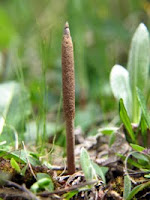
Dong Chong Xia Cao has a relatively recent history in Chinese herbal medicine: only some 300 years of documented use. It is classified as a Kidney yang tonic, which generally means a warming tonic but this herb doesn't damage yin in the process, so it's not too drying. It is especially known for its use in treating respiratory diseases as it settles coughs & wheezing. In recent decades. it's gained some notoriety for its use in improving Chinese athletes' performance. It is mostly harvested from the provinces of Tibet, Sichuan, & Qinghai, -- where its value has recently increased, even causing little frontier wars over collection rights. Despite its rather "icky" provenance, dong chong xia cao is considered a gentle tonic with very little toxicity.
Multiple sclerosis (usually just known as "M.S.") is a neurological disease of unknown etiology. It was recognized as a disease-syndrome in the 1868, by a famous neurological physician, Jean-Martin Charcot (this doctor conducted wide-ranging clinical work & research in neurological disorders, hysteria and hypnosis). For an unknown reason, the body itself apparently attacks the myelin sheath of the central nervous system, giving rise to a variety of neurological symptoms (changes in sensation, muscle weakness, fatigue & others).
Most modern pharmaceutical drugs are derived from herbs -- often from research that looks at herbs with specific medicinal functions. The working theory is that by extracting what is presumed to be the most "important" element of the herb, and then concentrating, or standardizing it, the resultant product will have an amplified ability to do whatever the source herb does. It's an interesting approach, this idea of isolating the single curative element from a raw material. But what if it's wrong? What if removing one element from an herb -- or one herb from a formula -- reduces its efficacy, or increases its toxicity, or unleashes heretofore unseen side effects? (Note that in this article, the isolated element of dong chong xia cao was too toxic for human use -- despite the herb's actual documented human use!)
Those other elements and additional herbs often have all those functions: they potentiate each other, they neutralize side effects, they negate toxicities, they increase bio-availability. The basic philosophical concept of Asian poly-pharmacy herbalism is of an herbal "community" of herbs working together in those ways inside of a formula that is actually part of the elegant art we call herbalism.
I find it interesting that this article looks at the concept of "retrieving" or "rescuing" valuable drugs from herbs used in medicinal traditions. I wonder what do modern researchers lose by looking at trying to take these traditional "tools" without their operating instructions? Happily, more & more clinical pharmaceutical-based medicine is turning towards the concept of working with polytherapies & the greater strength of combinations -- as for instance, the triple cocktail for HIV, and new malaria treatments.
Off-line Sources
1. Bensky, Clavey, Stoger. Chinese Herbal Medicine Materia Medica, 3rd ed.
2. Wu. Ben Cao Cong Xin.
Saturday, July 17, 2010
Oatmeal for Breakfast
I love cooking oats with cinnamon for breakfast. Oats are incredibly healthy and here is whyi:
Oats remove cholesterol from the digestive tract and arteries & strengthen cardiac muscles.
Oats can be used in cases of dysentery, diabetes, hepatitis, nervous and sexual debility, indigestion and swelling including abdominal bloating.
Oats help renew the bones and all connective tissue.
Oats contain phosphorus, required for brain and nerve formation during youth.
Oats are useful as a poultice to relieve itching. They also heal and beautify the skin when used as a pack.
If drunk regularly, oat water acts as internal antiseptic to strengthen immunity and ward off contagions.
In addition, oatmeal can regulates your digestive system. It is the best breakfast to eat if you have diarrhea or constipation or both (like in IBS).
How to cook cinnamon oatmeal?
3-4 full tablespoons of oats
2 cups of water
Cinnamon powder
1 Banana/pear/peach/apple
Walnuts
Honey
- In a small pot, use medium fire to warm the water with as much cinnamon as you like, for half a minute to let the water absorb the cinnamon.
- Add the oats, mix them into the cinnamon-water and keep it on low to medium fire for another half a minute. The reduce heat to very low, and cook for 5 minutes. Gently stir it 2-3 times.
- Meanwhile, cut a banana & wash a handful of walnuts. When the oats are cooked pore the oatmeal into a bowl, then add the banana, and the walnut, and add some honey on the top for extra sweetness.
If you don't have banana, you can use a pear, a peach or even an apple. Since the fruits are sweet, you can choose not to add the honey.
Coconut: sometimes I add shredded coconut to the cooking oats, and cook with it for couple of minutes.
You can change the amount of water and oats to get more liquid-like or thick-like oatmeal.
Some people like their oatmeal salty....so I guess that would be without cinnamon, fruits, nor honey, just salt.
After a big bowl like that, I am full for at least 5 hours.
Enjoy!
Eran Pupkin
i Paul Pitchford, Healing with Whole Foods, page 469
Subscribe to:
Posts (Atom)
